Isle Royale National Park is currently accepting public feedback on what to do, if anything, to conserve the island’s dwindling, inbred wolf population. Currently there are eight adult wolves and an unknown number (two or three) of pups.
Three options are under consideration:
do nothing, even if wolves go extinct
allow wolves to go extinct and then introduce new wolves
introduce new wolves through genetic rescue (introducing adult wolves to the island to offset inbreeding)
We lunched at the Greenstone Grill one last time. We’d had the same server all the times we’d been there. Her name was Katie, and although she’d worked on the north rim of the Grand Canyon last summer, she hailed from Ferndale, Michigan.
After lunch, we had some time for last-minute souvenir shopping while we waited to board the ferry. Adam struck up a conversation with Ranger Lauren in the visitor center. She explained how about forty of the park’s sixty-five summer staff were seasonal since the park shuts down between October and April, and that she’d essentially be laid off at the end of the season. She hoped, though, to return to Isle Royale next year. She also said that full-time, established rangers are able to move from park to park until they find the one they want to stay at.
It was our final morning on Isle Royale. We’d be taking the ferry back to Copper Harbor at 2:45 that afternoon. First thing, Adam went down to the dock to see if they were letting people rent motorboats that day.
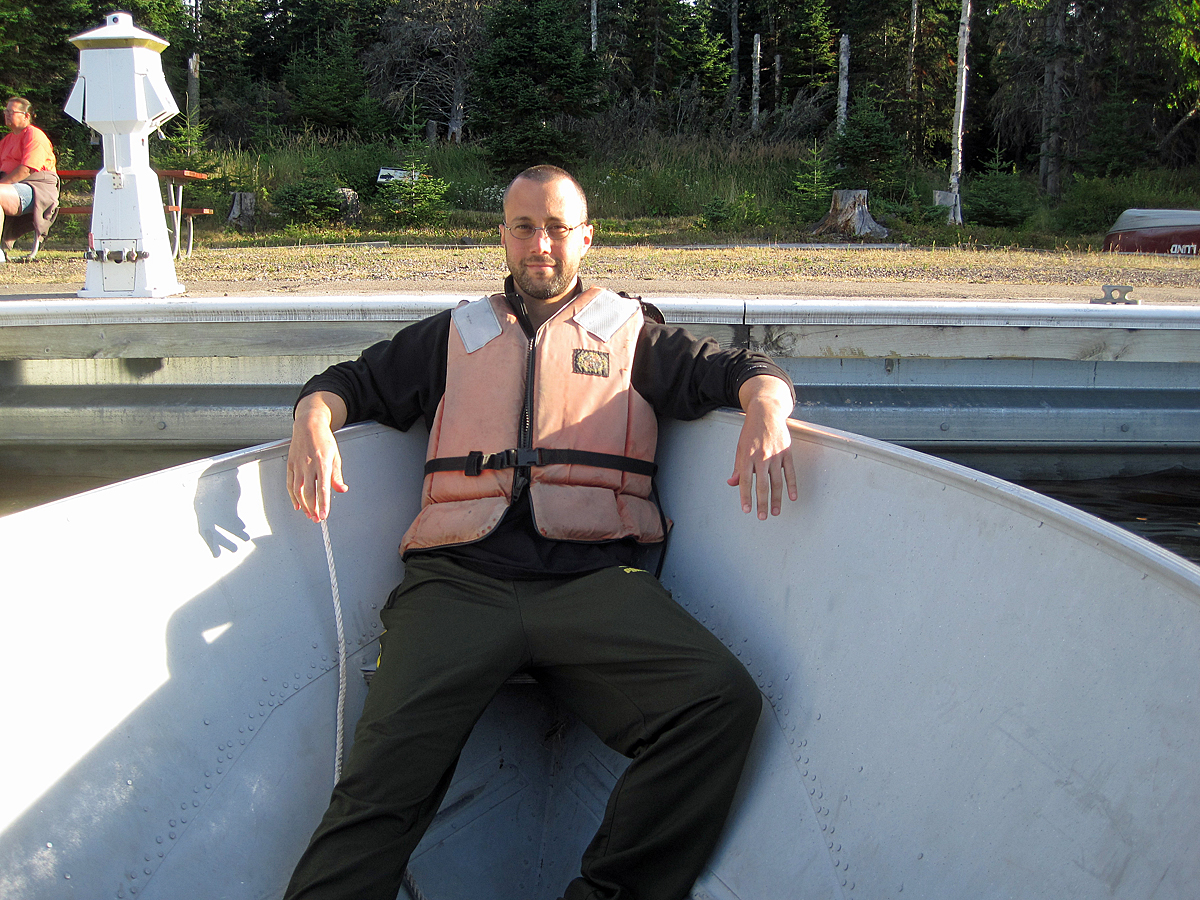
They were, so Adam and Phil made the arrangements while Sean and I got a breakfast table at the Grill. Afterward, we donned our life jackets and headed out into Rock Harbor, just before the Ranger III set sail.
As we neared Rock Harbor, we came across Smithwick Mine from the mid-1800s. Like Siskowit Mine, it’s a huge pit from which the miners extracted copper.
Scoville Point is the northeast tip of the peninsula ridge that houses Rock Harbor Lodge and visitor center. It is at the end of the 4.2-mile loop of Stoll Trail. We set out with little more than water for an afternoon hike there and back.
We reached Rock Harbor in the late afternoon, and to our relief, we had our pick of campsites. There were even shelters available. We looked at one, but decided that we simply preferred to sleep in our tents.
Thursday morning we woke up and took stock. In our original itinerary, tonight would have been when we camped at Daisy Farm, but we’d already been here two nights. Already the regret of not having made it to a campground on an interior lake, with an increased likelihood of seeing more wildlife, was hugely mitigated by having been at Daisy Farm the evening before for Candy Peterson’s talk.
We decided to begin the hike back to Rock Harbor where, Friday night, we had a room reserved at the lodge. Our goal for Thursday, however, was Three Mile. We hoped to get the same lovely, harbor-side campsite we’d had Monday night, or at least the one adjacent.
There was only a sprinkle of rain overnight, enough to make the rain cover useful, but by morning the sky was clear.
We breakfasted on strong coffee and dehydrated eggs, which were not my particular favorite. Phil was still feeling poorly, so he decided that he wouldn’t be joining us on our day hike up Mount Ojibway, at 1,133 feet, the highest point on the northeast side of the island.
We arrived at Daisy Farm early in the afternoon, so we had our pick of camp sites. We chose a lovely secluded spot in the forest and began to set up camp. Earlier on the trail, when we decided to stop at Daisy Farm, Adam and I toyed with the idea of doing the trail to Mount Ojibway as a day hike later in the afternoon. Once we began to unpack, however, we decided simply to stay put. In fact, we unanimously decided that we’d stay two nights at Daisy Farm to give Phil time to feel better. The forecast called for a chance of rain that night, so we pulled out the rain flies for our tents.
We woke late at Three Mile, sore from the unexpectedly long hike the day before, but in good spirits. Adam and Phil filtered water and started breakfast, while I tended to my blisters and Sean tidied camp. The weather was gorgeous, sunny with a breeze off the water. We were able to look about us and see just how lovely our campsite was.
Crossing the Greenstone Ridge, we set off on the Lane Cove Trail, glad to be headed downhill, and about two thirds of the way through our hike for the day. The north side of the ridge is much steeper than the south side, and we were rewarded with a lovely view out into Lake Superior to the north. The trail descended in a series of steep switchbacks through a forest dominated by tall birches. Everything felt more lush, and somehow wilder, on this side. (more…)
We dropped off a pair of daypacks with clean clothes at the lodge to be held until we came back for our final night. Then we lunched at the Greenstone Grill before heading out toward Lane Cove Campground.
We had set our alarms for 6:30am Monday morning, but we were all awake before that, particularly early riser, Phil, who had scouted out a source of coffee before the rest of us were out of bed.
Sean at Michigan Department of Transportation Baraga Cliff Roadside Park Honoring Peter R. Kamarainen
Adam and Phil arrived Saturday evening from Detroit. Sean and Phil poured a round of drinks (Moscow Mules and rye on the rocks), and we set to work over the topographical map of northeastern Isle Royale. We hit upon an ambitious but achievable hiking route:
Day One: Rock Harbor to Lane Cove, 6.9 miles
Day Two: Lane Cove to East Chickenbone Lake, 10.9 miles
Day Three: East Chickenbone to Lake Richie, 5 miles
Day Four: Lake Richie to Daisy Farm, 5.8 miles
Day Five: Daisy Farm to Rock Harbor, 7.1 miles
Afterward, we sorted meals, took a clipper to my longish hair, and went to bed.
Unique among the national parks, the mere facts of Isle Royale create an evocative and compelling portrait:
Forty-five miles long, it is the largest island in the largest freshwater lake (by surface area) on earth. Its backbone, the Greenstone Ridge, was formed by the largest single lava flow on the planet, exposed by the glacier that melted to form Lake Superior.
With 16,000 annual visitors, the sixty-one year-old national park is the least-visited in the contiguous United States, and the fourth-least visited in the entire system. The only parks that see fewer annual visitors lie above the Arctic Circle or on American Samoa. An oft-quoted figure is that fewer people visit Isle Royale in an entire year than visit Yosemite or Grand Canyon in a day. It is only accessible via ferry or sea plane. It shuts down completely between October and April.
Designated a United Nations Biosphere Reserve, ninety-eight percent of the park is wilderness area.
Famous for its moose (which swam to Isle Royale from the mainland in the early years of the twentieth century) and for its wolves (which crossed an ice bridge from Ontario in the late 1940s), it boasts only a handful of mammal species: snowshoe hares, red squirrels, river otters, beavers, deer mice, bats, foxes. It is either inhospitable or inaccessible to deer, caribou, rats, and bears.
As a native Michigander, I felt that Isle Royale was the ideal park to launch this ambitious project. I spent six days in the park with my partner, Sean, and buddies, Adam and Phil.
This is the first in a series of posts about the trip.
Between finalizing reservations, assembling gear in earnest, and thinking on a hiking itinerary, I’m getting rather excited to visit Isle Royale. I’m nervous though, about several things. Utmost among them is concern that I won’t be able to sleep. I am a fetal-position sleeper, and sleeping pads and mummy sleeping bags are simply designed for people who sleep on their backs.
I’m also nervous, frankly, that the entire trip may be canceled. Now, if Republicans in the US House do force the Federal Government into default, there will likely be many more egregious results than the National Park System shutting down (like a halt in Social Security payments, for instance). But it would mean that we would not be able to go.
It lends a sense of fragility to the entire enterprise, belied by the sentiments in Ken Burns’ stellar documentary about the creation of the National Park System. Yes, these places are protected “in perpetuity” by a government and democracy that seem, sometimes, all too fragile themselves.
Yesterday, Sean and I spent some time at REI here in Chicago. We tried on several backpacks for next month’s Isle Royale excursion. Ultimately, we both went home with the same pack: the Osprey Atmos 65. Sean liked the way it fit and distributed weight. I very much liked the ventilation system between my back and the pack.
I also ordered our tent: the REI Camp Dome 2, which should arrive on Friday. We may try it out in Wisconsin in a few weeks in advance of going to the island.
This morning, we tried a freeze dried spinach omelette that we picked up while we were at the store. Not too bad.
I need to continue breaking in the boots that I got last month, also at REI. I went with the Merrell Phase Peak waterproof boots. I loved the way they fit and gripped.